FSP exam in Mainz (Rhineland-Palatinate): cost, six parts, rules
Redaktion · 31 October 2026 · 10 min read
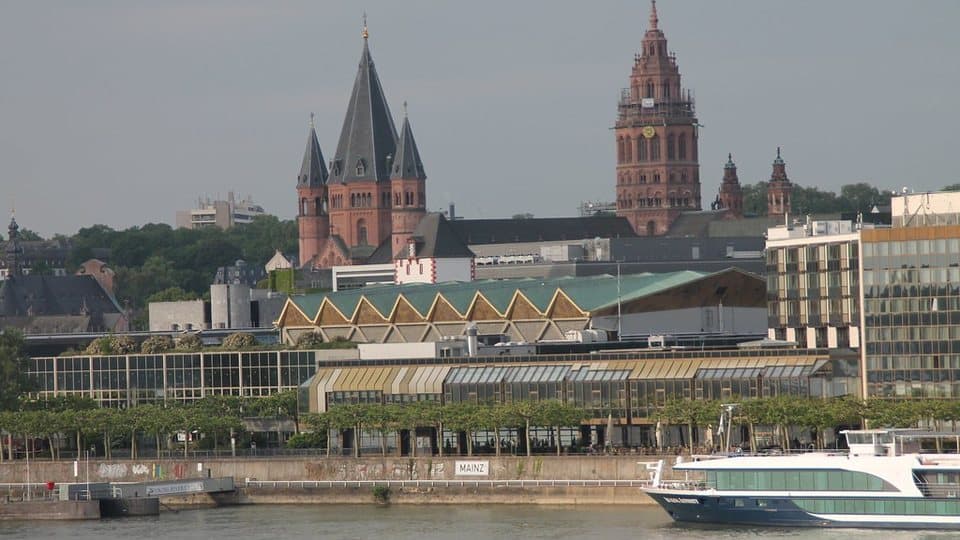
Foto: florian_bieser, CC0, Flickr
In short
In Rhineland-Palatinate (Rheinland-Pfalz) the FSP, the medical German exam for doctors, is held by the Bezirksärztekammer Rheinhessen in Mainz. It costs 470 euros (from 1 January 2026) and has six parts: vocabulary and body chart, free conversation, patient interview, history form, reading plus phone calls, doctor-to-doctor talk. Each part has a minimum score; miss one and the exam is stopped.
Who runs the FSP in Rhineland-Palatinate?
You apply for your Approbation (full medical licence) or Berufserlaubnis (temporary permit) at the Landesamt für Soziales, Jugend und Versorgung (LSJV) in Koblenz, the state licensing office. The FSP itself is run on its behalf by the Bezirksärztekammer Rheinhessen, a district branch of the state medical chamber. Exams take place in Mainz, Bauhofstraße 5a; the office is at Mittlere Bleiche 40. The chamber answers by email only, not by phone.
The panel is two people with medical experience, usually both licensed doctors, at least one. Both are native German speakers. The exam tests your German, not your medicine. The chamber writes: „Medizinische Fehler oder fehlendes medizinisches Wissen werden nicht bewertet“ (medical errors or missing medical knowledge are not marked).
How do I register, and when do I get a date?
- Apply to the LSJV and wait for the „Qualifizierte Eingangsbestätigung“ (qualified confirmation of receipt). Those words appear in the letter's subject line. Without it the chamber will not process your registration.
- Email the current registration form with each document as a separate PDF: a short CV, the confirmation letter, passport or ID, and a German certificate at B2 or higher. If you have them: a job offer or a Hospitation (observership) in Rhineland-Palatinate, plus a mobile number and email address.
- The chamber asks you in writing to pay. Pay only then, using the reference it gives you. No date is assigned until the money has arrived.
- You may name your earliest possible date, but not a specific day. The invitation arrives at least two weeks ahead, often earlier.
Who goes first: applicants with a job offer or observership in Rhineland-Palatinate, and applicants who live there, are invited first. Invitations go out quarter by quarter:
| Exams in | Invitations from about |
|---|---|
| January to March | mid-November of the year before |
| April to June | mid-February |
| July to September | mid-May |
| October to December | mid-August |
Still abroad and need a visa? The chamber can invite you with at least eight weeks' notice once all documents are in and the fee is paid.
How much does the FSP cost in Rhineland-Palatinate?
| Item | Rule |
|---|---|
| Fee | 470 € (information sheet in force from 01.01.2026) |
| When to pay | only after the written request; date only after payment arrives |
| Cancel or move more than 2 weeks ahead | half the fee is kept as a processing charge; you pay the half again for the new date |
| Cancel within 2 weeks, or no-show | the fee is lost, whatever the reason |
| Swap dates with another candidate | not allowed |
| Retake | new registration form and the full fee again |
An older information sheet from the chamber showing 425 euros still turns up in search results. It is out of date. Always download the form and sheet fresh from the chamber page; the chamber asks for the current form with every registration.
What happens in each part of the Mainz exam?
Mainz is different from almost every other chamber. Instead of three 20-minute parts there are six parts with different weights, and, as otherwise only in Saxony-Anhalt, reading and listening on the phone are tested on their own. Parts 1 to 5 can come in any order.
| Part | Time | What you do |
|---|---|---|
| 1: Verständnistest (vocabulary) | 20 + 5 min | translate 20 medical terms into the German patients use, and 20 German terms into the Latin or Greek terms doctors use; then three tasks on a body chart |
| 2: Free conversation | 10 to 15 min | a free, partly medical conversation; the examiners ask, you answer |
| 3: Anamnesegespräch (patient interview) | 20 min | talk to a patient, take the history and explain in plain everyday German; at the end you are told which tests to order |
| 4: Written part | 5 + 20 min | 5 min to fill in a test request form, 20 min for the four-page history form with every fact from the interview and your suspected diagnosis |
| 5: Reading and listening | 20 min | a one-page medical text, such as a doctor's letter or findings, with three questions; plus two phone calls whose content you write down |
| 6: Doctor-to-doctor talk | 15 to 20 min | a professional conversation with a senior doctor (Oberarzt), for example reporting on the patient or the calls, in medical German |
That adds up to about two hours of exam time. Including waiting, the chamber says to allow 3 to 3.5 hours. Bring your passport or ID. Hand in phones, tablets and smartwatches on arrival without being asked. During the written parts you sit in a room that may be watched by video camera. The Mainz documents do not mention a dictionary.
How is it marked? The stop rule
This is the biggest difference from other chambers. The chamber states three rules:
- Every part has its own minimum score. Miss it in one part and the whole exam is failed.
- The exam is stopped as soon as a finished part falls below its minimum. The remaining parts do not take place.
- The minimums alone are not enough. Overall you need more than 60 percent of all points. If you only just reach the minimum in one part, you must make up for it with above-average scores elsewhere.
The chamber does not publish how many points each part has or where the minimums lie. The chair tells you the result right after the exam. If you pass, you receive an original certificate; if you fail, you get none.
Which rules cost points in Mainz?
The chamber's process notes (Ablaufhinweise) are unusually precise. They apply only here, and they catch out many candidates who prepared with material for other chambers:
| Part | Chamber rule |
|---|---|
| 1: Vocabulary | Translate, do not explain (the chamber's example: Antebrachium = Unterarm, not „Teil des Arms oberhalb der Hand“). Capitalise nouns, lower-case everything else. One translation only per term; two cost points |
| 1: Body chart | marks in exact form, no bigger than needed, as precisely as possible over the right spot |
| 3: Interview | A complete history is not required. Answer the patient's questions at once, even in the middle of the history, not at the end: otherwise „Punktabzug bis hin zum Nicht-Bestehen“ (deductions up to failing). Get numbers and names right, ask for unknown words to be spelled, do not run a memorised question list |
| 4: History form | Page 1 (current history) in full sentences. Pages 2 and 3 without full sentences, or you lose points. Do not turn the patient's words into medical terms: „Eine Anamnese ist kein Arztbrief“ (a history is not a doctor's letter). Medical terms only on page 4 |
| 4: Test request | Fill in every field. The question is addressed to a colleague, so medical German; the clinical details as the patient reported them |
| 5: Reading and listening | Answer as briefly and precisely as possible. Long answers with information nobody asked for lose points. Note the calls on a separate sheet first, then copy them neatly; ask for names to be spelled |
| All parts | anything that cannot be understood or read lowers your score |
The chamber suggests learning the vocabulary from medical dictionaries such as the Pschyrembel. How to switch between medical terms and patient language is shown in FSP medical terms in patient language.
What is on the Mainz history form?
The chamber publishes the form as a PDF. You get it already for the interview in part 3, and keep writing on the same form in part 4. Every fact from the interview must be on it, as proof that you understood.
| Page | Fields | Style |
|---|---|---|
| 1 | candidate name, date, patient name, date of birth, age, weight, height, place of residence, family doctor, job, marital status, children, current history | current history in full sentences |
| 2 | previous illnesses and operations, family history, gynaecological history | notes, patient's words |
| 3 | vegetative history (temperature, sleep, appetite, bowels, urination), mental state, medication, Genussmittel/Drogen (alcohol, tobacco, other drugs), allergies and intolerances | notes, patient's words |
| 4 | suspected diagnosis, differential diagnoses, tests discussed with the patient | medical terms here |
Rhineland-Palatinate vs Westphalia-Lippe: what is different?
Westphalia-Lippe uses the „Westfälisches Modell“ of three 20-minute parts that most chambers copied. Side by side, you can see how much more Mainz asks for:
| Rhineland-Palatinate (Mainz) | Westphalia-Lippe (Münster) | |
|---|---|---|
| Fee | 470 € | 400 € |
| Parts | 6, about 2 hours of exam time | 3 of 20 minutes each |
| Vocabulary | 20 + 20 in two directions plus a body chart, its own part | vocabulary list at the end of part 3 |
| Written part | 4-page history form on paper, plus a test request | template by hand or on a PC |
| Dictionary | not mentioned in the documents | provided and allowed |
| Reading and phone calls | yes, its own part | no |
| Result | right after the exam, certificate if you pass | orally right after, in writing the following week |
For your preparation this means: in Mainz, practising the interview, the report and the handover is not enough. You also need 40 terms in two directions, questions on a doctor's letter, and taking notes from phone calls. All 17 chambers side by side are in FSP exam in Germany: cost and format in all 17 chambers.
Failed: what happens next?
You can retake the exam. The chamber names no maximum number of attempts. The panel recommends a preparation period before the retake. The chamber only shortens it for compelling personal reasons, such as your visa running out or a new job offer in Rhineland-Palatinate, and only with written proof. For every retake you download the current form again and pay the fee again. Even after the recommended period, your date depends on free places.
Common mistakes in the patient interview, including putting off the patient's questions, are covered in FSP patient interview: common mistakes.
What applies after the exam?
The chamber points out a rule of this state: with a Berufserlaubnis you may work for pay in a hospital or practice. But in Rhineland-Palatinate you can only start specialist training (Weiterbildung) once you hold the Approbation or have passed a Kenntnisprüfung (knowledge test). The reason is the state's law on the health professions. Questions about your own application go to the LSJV.
Practise each part under real time: vocabulary against a stopwatch, the interview out loud, the form by hand in 20 minutes. Timed tasks are on our practice page.
Frequently asked questions
Where is the FSP exam in Rhineland-Palatinate held?
In Mainz, Bauhofstraße 5a. The Bezirksärztekammer Rheinhessen runs it for the state medical chamber and the LSJV in Koblenz.
How much is the FSP exam fee in Rhineland-Palatinate?
470 euros, according to the Bezirksärztekammer Rheinhessen's information sheet in force from 1 January 2026. You pay only after a written request, and every retake costs the full fee again.
How long is the FSP exam in Mainz?
Six parts with about two hours of exam time in total. Including waiting, the chamber says to allow 3 to 3.5 hours.
What happens if I fail one part of the Mainz FSP?
Each part has a minimum score. If a finished part falls below it, the panel stops the exam and the whole exam is failed.
How many vocabulary terms are in the Rhineland-Palatinate FSP?
40: 20 medical terms into patient German and 20 German terms into Latin or Greek, plus three tasks on a body chart, all in 25 minutes. A translation is required, not an explanation.
What does it cost to cancel the FSP in Mainz?
More than two weeks before the date, half the fee is due. If you cancel later or do not turn up, the whole fee is lost, whatever the reason.
Sources
- Bezirksärztekammer Rheinhessen: Ärztliche Fachsprachenprüfung, checked 23 October 2026
- Bezirksärztekammer Rheinhessen: Informationen zur Fachsprachenprüfung (PDF, in force from 01.01.2026), checked 23 October 2026
- Bezirksärztekammer Rheinhessen: Ablaufhinweise zur Fachsprachenprüfung 2024 (PDF, as of 13.12.2023), checked 23 October 2026
- Bezirksärztekammer Rheinhessen: Anamnesebogen Fachsprachenprüfung (PDF), checked 23 October 2026
- Ärztekammer Westfalen-Lippe: Fachsprachenprüfung, checked 23 October 2026