FSP exam in Berlin: cost, process and how it is marked
Redaktion · 28 October 2026 · updated 3 November 2026 · 10 min read
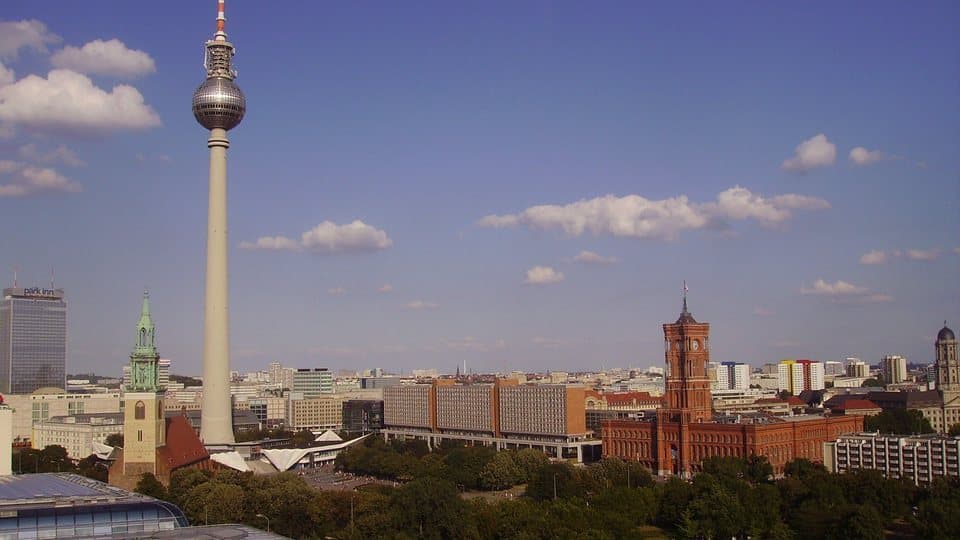
Foto: Zairon, CC0, Wikimedia Commons
In short
The FSP (Fachsprachprüfung, the medical German exam for doctors) in Berlin is held by the Ärztekammer Berlin at Friedrichstraße 16 and costs 550 euros. You can only register once the LAGeSo has confirmed your licence application. There are three parts of 20 minutes each. You pass only with at least 12 of 20 points in every part. Results come at the earliest ten days later.
Who runs the FSP in Berlin?
If you applied for your Approbation (full medical licence) at the LAGeSo (Landesamt für Gesundheit und Soziales, Berlin's state office for health and social affairs), you take the exam at the Ärztekammer Berlin, Friedrichstraße 16, 10969 Berlin. The LAGeSo, not the chamber, decides whether you need the exam. You are usually exempt if you completed at least ten years of general schooling at a German-language school, or at least three years of vocational training in German.
The exam tests German for everyday medical work at level C1: the LAGeSo requires you to prove the German your job needs in a „Fachsprachentest (C 1)“ (specialist language test) at the chamber. The chamber and the LAGeSo both use the same sentence: „Es geht nicht um die Überprüfung von Fachwissen“ (this is not a test of medical knowledge). Your language is marked, not whether your diagnosis is right.
How do I register?
- You apply to the LAGeSo for the Approbation or the Berufserlaubnis (temporary work permit).
- After checking your application, the LAGeSo sends an Eingangsbestätigung (confirmation of receipt) stating that you need the FSP. Only with this letter can you register with the chamber.
- You fill in the chamber's online form. In the field „Bemerkung/Prüfungsverfügbarkeit“ (remarks and availability) you can say when you are free.
- You send by email, letterbox or post: the printed and signed form, a copy of your valid ID card or passport, and the LAGeSo confirmation. If someone else registers you, add an original, signed power of attorney.
- Once your documents are complete, you receive a fee notice for 550 euros. You pay by bank transfer within two weeks; cash is not accepted.
- After payment the chamber asks by email whether you want the next free date. You confirm in writing, and the invitation arrives at least two weeks before the exam.
The Berlin chamber does not publish exam dates. It gives them only on request by email (fachsprachpruefung@aekb.de) or phone. It states no waiting time. It says it takes your preferred times into account where possible.
How much does it cost, and what if I cancel?
| Situation | What applies |
|---|---|
| Exam | 550 €, by bank transfer in advance, within two weeks of the fee notice |
| Cancelling before the invitation or up to 14 days before the exam | free, the fee is refunded |
| Cancelling later with an important reason | 100 € charged as a handling fee (Aufwandsentschädigung), the rest refunded; no new registration |
| Cancelling later without an important reason | new registration and a new fee |
| Retake | new registration and 550 € again |
What happens on the exam day?
It is an individual exam built around a realistic hospital or practice case. At least two examiners sit on the panel, at least one of them a doctor. Bring a valid ID card or passport.
| Step | Time | What happens |
|---|---|---|
| Introductions | short | The examiners introduce themselves and invite you to say a few words about yourself and your career |
| Part 1: Simulationsanamnese (simulated patient interview) | 20 min | take a history from an actor patient, share your suspected diagnoses, explain tests and treatment in plain language |
| Part 2: Dokumentation (written report) | 20 min | a short report for colleagues on a structured template, on the computer or by hand |
| Part 3: Ärztliches Gespräch (doctor-to-doctor talk) | 20 min | present the case to a senior doctor and answer questions; then 5 medical terms, 2 abbreviations, 3 lab values |
What does each part ask for?
Part 1, patient interview. You ask for personal details, current complaints, past illnesses, medication and family history. Then you tell the patient your suspected diagnoses, explain them when asked, propose further tests and treatment and explain what will happen. The chamber asks for words a patient understands and, where possible, no technical terms. You may take notes; nobody checks them, but you hand them in at the end.
Part 2, written report. You summarise the case as a Kurzbericht (short report) on a structured template. One rule is fixed: „Formulieren Sie zumindest die aktuelle Anamnese in ganzen Sätzen“ (write at least the current history in full sentences). You choose between the computer provided and handwriting. You may use your notes from Part 1 and a medical dictionary that is provided.
Part 3, doctor-to-doctor talk. A doctor on the panel plays the senior physician. You report on the case and answer questions, now in technical language. At the end you translate five medical terms into German, complete two abbreviations and read out three lab values with numbers and units.
How is the Berlin FSP marked?
Berlin is the only chamber that publishes its marking sheets. Each part has its own sheet with eight criteria. Each criterion scores 2.5 (very good), 2 (good), 1.5 (satisfactory), 1 (not satisfactory), 0.5 (poor) or 0 (missed entirely). So a part is worth at most 20 points, and you pass it with 12. The examiners circle the scores; the chamber's office adds them up. All 24 criteria side by side:
| No. | Patient interview: the candidate … | Written report: the document … | Doctor-to-doctor talk: the candidate … |
|---|---|---|---|
| 1 | builds a professional and personal rapport | can be matched to the patient with certainty (only 2.5, 1.5 or 0) | presents the case fluently and appropriately |
| 2 | speaks clearly and in detail | is structured and complete | speaks grammatically correctly and clearly |
| 3 | has clear, understandable pronunciation | is grammatically correct | uses medical terms correctly and in the right amount |
| 4 | departs usefully from set question schemes | is correctly spelled | states findings and treatment steps clearly |
| 5 | leads the conversation with a clear aim | shows the necessary detail | answers follow-up questions without language problems |
| 6 | explains things fluently | uses medical terms correctly and in the right amount | can take part in a discussion of the case |
| 7 | understands the other person without problems | reproduces the key history findings correctly in meaning | translates 5 medical terms into German |
| 8 | explains next steps clearly and in a patient-friendly way | states the key treatment steps clearly | completes 2 abbreviations and reads 3 lab values correctly |
Three things stand out when you lay the sheets side by side. First: in Part 1, understanding (criterion 7) counts as much as pronunciation; asking again costs nothing, a misunderstanding does. Second: spelling is only marked in Part 2, grammar in Parts 2 and 3. Third: in Part 3, two of eight criteria, so 5 of 20 points, depend on the small tasks with terms, abbreviations and lab values. That is a quarter of the part for a few minutes of work.
When do I pass? Three worked examples
The chamber's rule: you pass „wenn in jedem Prüfungsteil mindestens 60 % der Gesamtpunktzahl erreicht werden“ (if you reach at least 60 % in every part). The total alone does not decide. The examples are our own and only show the arithmetic:
| Example | Part 1 | Part 2 | Part 3 | Total | Result |
|---|---|---|---|---|---|
| A | 15 | 11.5 | 16 | 42.5 of 60 | fail: Part 2 is below 12 |
| B | 12 | 12 | 12 | 36 of 60 | pass: every part has 12 |
| C | 18 | 12.5 | 11 | 41.5 of 60 | fail: Part 3 is below 12 |
When do I get my result?
Unlike many chambers, Berlin does not tell you the result on the day. It is ready ten days after the exam at the earliest. If you pass, the chamber emails you a certificate as a PDF and informs the LAGeSo first. You forward the certificate to bqfg@lageso.berlin.de or post a copy, and your licence application continues. The chamber asks candidates not to phone about results; check your spam folder too.
Failed: how often can I retake it?
- As often as you need. Each retake needs a new registration and another 550 €.
- You always retake the whole exam, not just the part you failed.
- The chamber recommends at least three months of preparation, working on the examiners' recommendations. Every marking sheet has a field „Empfehlung zur Nachbesserung der Sprachkenntnisse“ (recommendation for improving language skills).
- You cannot lodge an objection to the result with the chamber. Administrative decisions in your licence procedure are made by the LAGeSo.
- The LAGeSo does not ask for proof of a failed attempt.
How other chambers handle retakes: FSP failed: retake rules in every German medical chamber.
Berlin, Bavaria and Westfalen-Lippe compared
| Berlin | Bavaria (Munich) | Westfalen-Lippe (Münster) | |
|---|---|---|---|
| Fee | 550 € | 550 € | 400 € |
| Structure | 3 parts of 20 min | 3 parts of 20 min | 3 parts of 20 min |
| Examiners | at least 2, at least 1 doctor | 2 doctors and 1 linguist | 3, at least 2 licensed doctors |
| Written report | computer or by hand, medical dictionary provided | not stated on the chamber page | template by hand or PC, dictionary provided |
| Pass mark published | yes: 12 of 20 in every part | no | no |
| Result | after 10 days at the earliest, by email | orally on the exam day | orally straight after, in writing the following week |
| Retakes | unlimited, 550 € each | currently unlimited, at least 3 months recommended | unlimited, 3 to 6 months recommended |
All 17 chambers with fees and structure: FSP exam in Germany: cost and format in all 17 chambers.
How do I prepare for the Berlin FSP?
The chamber offers no preparation course. Your biggest advantage in Berlin is that you know the marking sheets. Use them as a checklist. Record a practice interview, score it yourself with the eight Part 1 criteria and ask a second person to do the same.
Practise the small Part 3 tasks aloud for a few minutes every day. Our own examples: Dyspnoe is Atemnot (shortness of breath), Pruritus is Juckreiz (itching), Emesis is Erbrechen (vomiting). You read „Kalium 4,2 mmol/l“ as „Kalium vier Komma zwei Millimol pro Liter“, and „Hb 12,8 g/dl“ as „Hämoglobin zwölf Komma acht Gramm pro Deziliter“. Note the German decimal comma. The chamber does not publish which terms and values come up. How to combine structure and full sentences in the report: the Arztbrief in the FSP exam. Timed exam practice is under practice.
Frequently asked questions
Where is the FSP exam held in Berlin?
At the Ärztekammer Berlin, Friedrichstraße 16, 10969 Berlin. This applies if your licence application is with the LAGeSo Berlin.
How much does the FSP exam cost in Berlin?
550 euros, paid by bank transfer within two weeks of the fee notice. Every retake costs another 550 euros.
What is the pass mark for the FSP in Berlin?
At least 12 of 20 points in each of the three parts. If one part is below 12, you fail, even if your total is above 36.
When do I get my FSP result in Berlin?
Ten days after the exam at the earliest. If you pass, you receive a PDF certificate by email and forward it to the LAGeSo.
Does telc Deutsch B2·C1 Medizin replace the FSP in Berlin?
No. The LAGeSo Berlin only accepts a passed FSP of the Ärztekammer Berlin.
How many times can I retake the FSP in Berlin?
As often as you need, but always the whole exam, with a new registration and fee. The chamber recommends at least three months of preparation.
Sources
- Ärztekammer Berlin: Fachsprachprüfung, checked 22 October 2026
- Ärztekammer Berlin: Aufgabenstellung Fachsprachprüfung (PDF), checked 22 October 2026
- Ärztekammer Berlin: Musterbewertungsbogen Simulationsanamnese (PDF), checked 22 October 2026
- Ärztekammer Berlin: Musterbewertungsbogen Schriftliche Dokumentation (PDF), checked 22 October 2026
- Ärztekammer Berlin: Musterbewertungsbogen Ärztliches Gespräch (PDF), checked 22 October 2026
- LAGeSo Berlin: Hinweise zum Fachsprachentest für Ärztinnen/Ärzte, Stand März 2026 (PDF), checked 22 October 2026
- LAGeSo Berlin: Approbation und Berufserlaubnis, Ausbildung im Drittstaat (Sprachkenntnisse, Fachsprachentest C 1), checked 3 November 2026
- Bayerische Landesärztekammer: Fachsprachenprüfung, checked 22 October 2026
- Ärztekammer Westfalen-Lippe: Fachsprachenprüfung, checked 22 October 2026